In a previous article, I spoke about the Paradox of Evolution, where I posed a dilemma: while technology gains astounding speed, human evolution seems to stall.
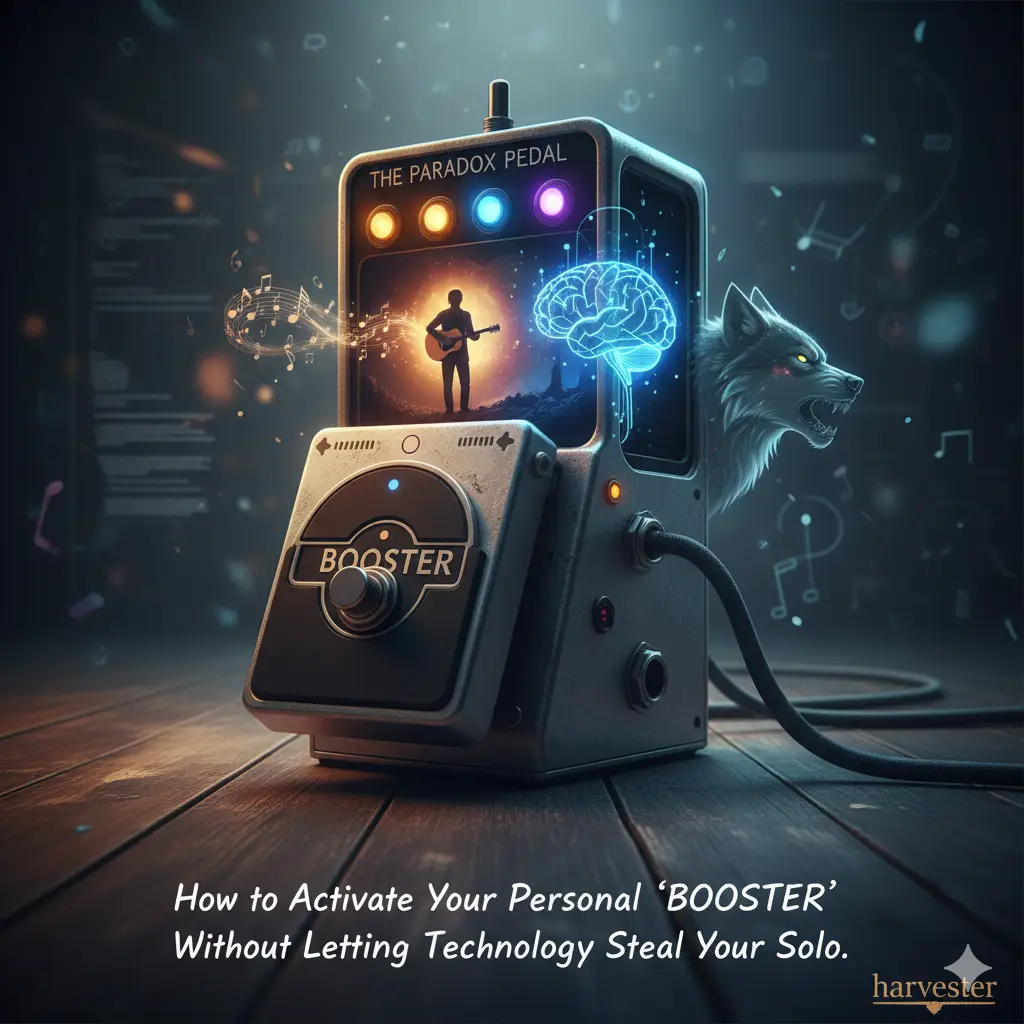
It is here that we find an analogy that obsesses me. I relate it to a guitarist’s BOOST pedal. It’s a pedal that, when stepped on, doesn’t create a new sound, but amplifies the sound that already exists. It elevates it, gives it presence, and pushes it to the center of attention during a solo.
Today in our daily lives, Artificial Intelligence and automation tools are our Technological BOOST. They give us speed and efficiency never before seen. But the essential question is not technical, it is existential:
What Are We Amplifying? The Dilemma of the Inner Wolf
The essential question is: What are we amplifying? What is it that we are truly building every day? What do you think the future result of what you do today might be? The quality of your actions, your habits, and the consciousness of feeding the ideal sources will illuminate your attitude, passion, dedication, and love for what you like.
This reflection reminds me of a spirituality story that suggests we all carry an inner good wolf and a bad wolf. The crucial question is: Which one lives more? The wise answer is: The one we feed the most survives.
It is key to understand the quality of our actions and habits. It’s vital to feed ourselves from ideal sources that nurture what we are increasingly better at, illuminated by our attitude, passion, dedication, and love for what we like. If the foundation is solid, the BOOSTER will amplify your light.
And What About the Solo? The Talent Debt
After looking at the quality with which you feed your virtues, it remains to review in detail what you produce. In a way, it would be the same as having a talent, being strong and getting better at something, and not sharing it.
Your solo, your work, your creation, must go out into the world. Surely, according to the quality of your work, there will be people excited and motivated by what you do—people with affinities who can be an encouragement to your work, who support and motivate you to continue growing. Thus, become the creator of a great solo in each of your works, your creations, and contributions.
The Involution of the Creator Spirit
Technology has offered us unprecedented convenience, but it has driven us to become consumers of practical ideas and fashion trends for our lifestyle. We have become experts at living on the surface, embracing vanity and comfort as metrics of success.
In this process, there is a silent loss: that of the creator spirit.
We stop being the architects of our own value to become the exploiters of others’ creations. Our unique talent, that “gift” that anchors us and gives us meaning, is relegated to a secondary task—something we will do “when we have time.” The problem is not that technology exists; the problem is that technology has allowed us to forget the true value of the basic creation that sustains the soul.
The Return to the Basics: Humanism as BOOSTER
An idea revolves around my mind about the need to anchor ourselves in the fundamental. What would happen if the foundation of our society once again prioritized humanism?
“A basic core curriculum of liberal arts courses could be required for all students.”
This is not an academic proposal, but a call for human recalibration. The liberal arts (philosophy, history, art, ethics) are not “impractical” subjects; they are the tools that cultivate the soul, critical thinking, and the creator spirit that technology cannot replicate. If we all had that humanist foundation, we would understand that the true point of value is our talent. It is the authentic expression of our being that is dedicated to giving, creating, and growing.
The Recalibration Challenge: 3 Key Steps to Reassert Your Solo
If you feel the pace of technology is stealing your solo, don’t wait for the next tool to give you the solution. Change begins with a small intentional step today.
Here are three actions to stimulate the return to your essential talent:
- Reclaim Your “Unscheduled Time”: Dedicate 30 minutes, twice a week, to a talent or hobby that has no monetization or productivity goal. Go back to that instrument, that project, or that dream you have pending. Don’t call it a “hobby”; call it “Essential Research.” This is the protected time of your personal Lab.
- Identify Your “Value of Giving”: Think of your talent not as something you must sell, but as something you can offer. What knowledge could you share? What help could you give your community? The simple act of giving without expecting an immediate return is the antithesis of consumerism and activates your creator spirit.
- Get Rid of an “Idea Hustler”: Identify a practical idea or fashion trend you’ve adopted only out of vanity or convenience (e.g., a social network you hate using, a tool you don’t need). Discard it. By removing an “idea hustler” from your life, you free up mental and physical energy that you can redirect to your own creation.
The Solo Is Ours: Activating Essential Talent
The Technological BOOSTER is there to be used, but it must not dictate the melody. The solo is ours.
To activate the true personal BOOSTER—the one that amplifies our essence and not the noise of the system—we need to:
- Reaffirm Humanism: Invest time and energy in what cultivates our spirit: reflection, art, authentic connection.
- Activate Talent: Stop living off practical ideas of the moment and recommit to the gift we left stored away, like the guitarist who retakes a forgotten solo.
- Design Your Own Rhythm: Break with the programmed cycle of vanity and comfort, and design a rhythm of life aligned with giving and growing in a better way.
The BOOSTER is a powerful tool, but essential talent and the creator spirit are the essence worth amplifying. The solo is yours; don’t let the distraction steal it from you.
Exclusive Sneak Peek (Book Spoiler)
As technology continues to gain speed, our search for meaning becomes more urgent. And it is here, at this inflection point, that I am working on my next book, which I have considered calling BOOSTER.
The key question is not pressing the pedal, but how to ensure the solo we play is ours, and not just noise amplified by a machine. This is a conversation I am ready to have. If this idea resonates with you, accompany me on this exploration.